
Description
Wait, this language compiles ?...
We get: bytecode.pyc
Analyzing
We can try to use Pylingual but it doesnt work (we will learn later why)
So from experience of other ctfs lets use marshal to import the .pyc and read from it
import marshal, sys
data = open("bytecode.pyc","rb").read()
code = marshal.loads(data[16:])
print(code)
ns = {}
exec(code, ns, ns)
print(ns)
VERY BAD PYTHON SCRIPT BUT I WAS DOING IT FAST FOR THE SAKE OF THE FLAG
if we run this we with lastest python
$ python3 code_obj.py
<code object <module> at 0x556796faf170, file "hello.py", line 1>
Segmentation fault (core dumped)
It segmentation faults so we need to check which python version it is!
$ file bytecode.pyc
bytecode.pyc: Byte-compiled Python module for CPython 3.11 (magic: 3495), timestamp-based, .py timestamp: Tue Sep  9 19:54:47 2025 UTC, .py size: 6221 bytes
Python 3.11!
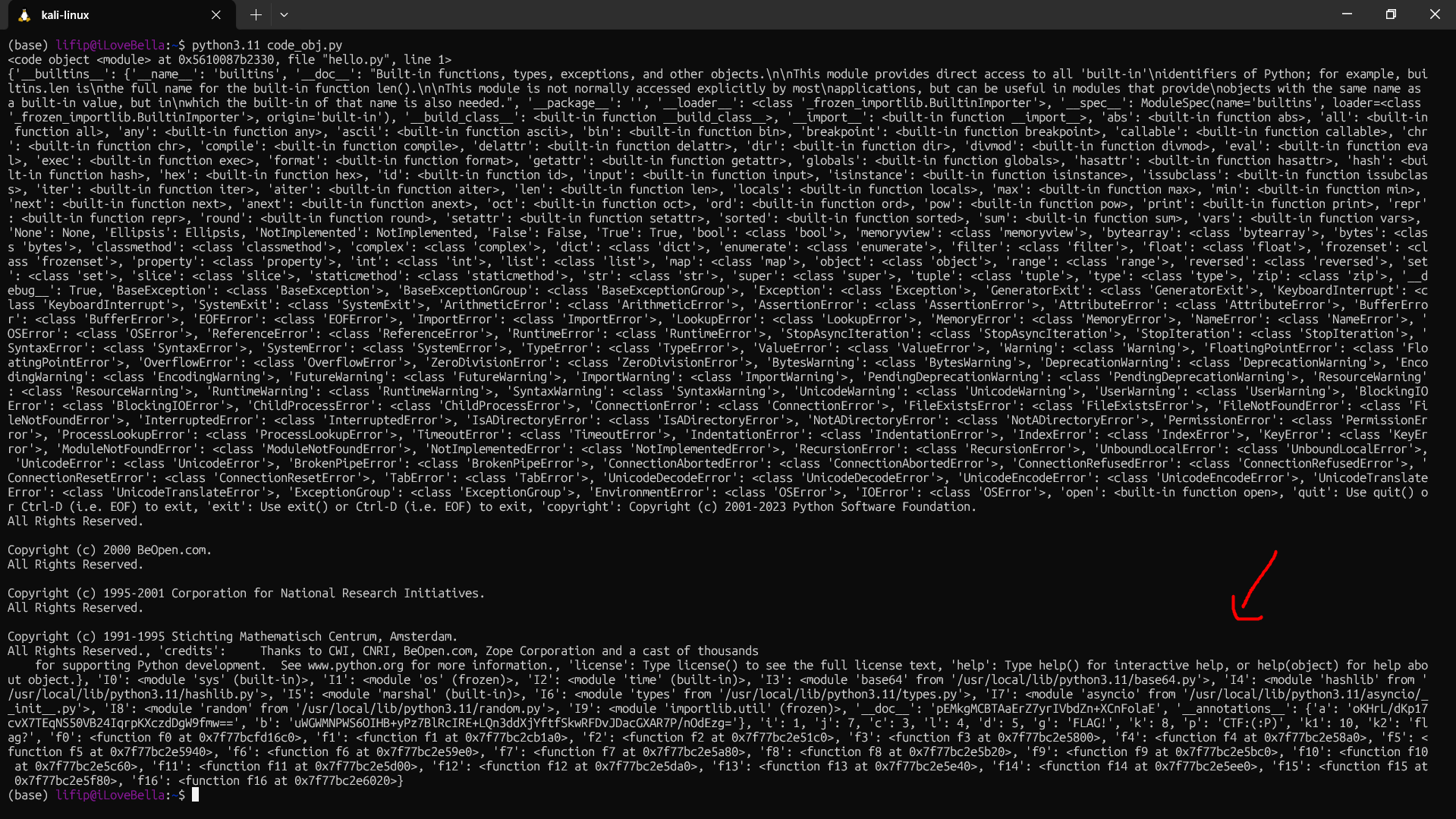
That is the import stuff. The functions names!
Something fishy I can see is this part:
'__doc__': 'pEMkgMCBTAaErZ7yrIVbdZn+XCnFolaE', '__annotations__': {'a': 'oKHrL/dKp17cvX7TEqNS50VB24IqrpKXczdDgW9fmw==', 'b': 'uWGWMNPWS6OIHB+yPz7BlRcIRE+LQn3ddXjYftfSkwRFDvJDacGXAR7P/nOdEzg='}, 'i': 1, 'j': 7, 'c': 3, 'l': 4, 'd': 5, 'g': 'FLAG!', 'k': 8, 'p': 'CTF:(:P)', 'k1': 10, 'k2': 'flag?',For the second script I wanted to read every functions name so I vibe coded decompiling.py
$ python3.11 decompiling.py bytecode.pyc
Wrote: decompiled_funcs/f0.txt
Wrote: decompiled_funcs/f1.txt
Wrote: decompiled_funcs/f10.txt
Wrote: decompiled_funcs/f11.txt
Wrote: decompiled_funcs/f12.txt
Wrote: decompiled_funcs/f13.txt
Wrote: decompiled_funcs/f14.txt
Wrote: decompiled_funcs/f15.txt
Wrote: decompiled_funcs/f16.txt
Wrote: decompiled_funcs/f2.txt
Wrote: decompiled_funcs/f3.txt
Wrote: decompiled_funcs/f4.txt
Wrote: decompiled_funcs/f5.txt
Wrote: decompiled_funcs/f6.txt
Wrote: decompiled_funcs/f7.txt
Wrote: decompiled_funcs/f8.txt
Wrote: decompiled_funcs/f9.txt

Done. Check the 'decompiled_funcs' directory for per-function .txt files.
Know I did some munca de batran chinez (my romanian people will understand it) and just looked through each one.
The f0 is an anti-debug / anti-decompile check:
=== DISASSEMBLY ===
 10           0 RESUME                   0

 11           2 LOAD_CONST               1 (('pylingual', 'decompyle3', 'uncompyle6', 'pycdc', 'pydevd'))
              4 GET_ITER
        >>    6 FOR_ITER                42 (to 92)
              8 STORE_FAST               0 (m)

 12          10 NOP

 13          12 LOAD_GLOBAL              1 (NULL + I9)
             24 LOAD_ATTR                1 (find_spec)
             34 LOAD_FAST                0 (m)
             36 PRECALL                  1
             40 CALL                     1
             50 POP_JUMP_FORWARD_IF_NONE     3 (to 58)

 14          52 POP_TOP
             54 LOAD_CONST               2 (True)
             56 RETURN_VALUE

 13     >>   58 JUMP_BACKWARD           27 (to 6)
        >>   60 PUSH_EXC_INFO

 15          62 LOAD_GLOBAL              4 (Exception)
             74 CHECK_EXC_MATCH
             76 POP_JUMP_FORWARD_IF_FALSE     3 (to 84)
             78 POP_TOP

 16          80 POP_EXCEPT
             82 JUMP_BACKWARD           39 (to 6)

 15     >>   84 RERAISE                  0
        >>   86 COPY                     3
             88 POP_EXCEPT
             90 RERAISE                  1

 17     >>   92 LOAD_GLOBAL              7 (NULL + I0)
            104 LOAD_ATTR                4 (gettrace)
            114 PRECALL                  0
            118 CALL                     0
            128 LOAD_CONST               0 (None)
            130 IS_OP                    1
            132 RETURN_VALUE
What it did exactly was checking for debuggers and if there was a debugger. f0 turns true.
From the f16 disasembly:
114  LOAD_GLOBAL f0
130  CALL 0
140  POP_JUMP_FORWARD_IF_FALSE 35 (to 212)
142  LOAD_GLOBAL print
154  LOAD_GLOBAL f14
166  LOAD_GLOBAL i
182  CALL 1
196  CALL 1
208  RETURN_VALUE
Readable:
if f0():            # anti-debug/decompile detected
    print(f14(i))   # print decoy
    return
What gets printed when no decoy?
In f16 after the anti-analysis breach we have this interested thing:
1040 LOAD_GLOBAL f15
1068 CALL 1          # (b, ok) = f15(i)
...
1088 boot['main'](b) -> run
...
print( run(bytes(mip)) )
f15(i) returns a marshalled code blob b and a boolean ok.
boot["main"](b) turns that blob into a real python function called run.
They call run(bytes(mip)) and print whatever it returns.
Let's check on boot['main'] from f11.
import marshal
def boot(b):
    c = marshal.loads(b)
    g = {}
    exec(c, g)
    return g['run']
def main(x):
    return boot(x)
So boot['main'](b) literally unmarshals a code object that contains a function run, executes it into a dict, and returns that run.
Next we need to look at f15:
LOAD_GLOBAL f12
LOAD_CONST '' ; LOAD_METHOD join
LOAD_GLOBAL i ; SLICE [:5]
LOAD_GLOBAL i ; SLICE [5:]
BUILD_LIST 2 ; CALL join
CALL f12
POP_JUMP_FORWARD_IF_FALSE 111 (to 348)
is this:
if f12("".join([i[:5], i[5:]])):f15 calls f12(i); if it’s False you get the decoy. Show readers the exact check:
import base64, hashlib
s = base64.b64decode(base64.b64encode(bytes.fromhex("736861323536"))).decode()
target = "".join([
 "0","2","e","e","5","f","3","7","b","7","2","8","4","f","a","3",
 "8","5","a","3","8","0","3","9","7","5","d","3","d","b","f","1",
 "8","9","7","3","c","2","1","e","5","b","a","f","d","6","3","f",
 "0","a","e","1","e","2","1","d","1","6","c","2","9","7","7","9"
])
print(s, target)
finding i with that exact SHA-256 is a preimage attack. we are not doing this at runtime!
The creator is very 👾👾👾!
INSIDE f13
Inside f13 we can find some encoded chunks:
=== Integer tuples found (useful arrays) ===
CONST_INDEX 2: [382, 356, 392, 430]
CONST_INDEX 3: [442, 544, 456, 552, 544, 538, 540, 446]
CONST_INDEX 4: [546, 548, 556, 446, 442, 556, 442, 448]
CONST_INDEX 5: [540, 542, 452, 544, 456, 546, 448, 456]
CONST_INDEX 6: [446, 540, 456, 548, 540, 538, 442, 546]
CONST_INDEX 7: [544, 554, 548, 548, 446, 450, 446, 540]
CONST_INDEX 9: [554, 538, 544, 448, 548, 554, 542, 452]
CONST_INDEX 10: [456, 442, 546, 542, 556, 554, 542, 542]
CONST_INDEX 11: [544, 550, 554, 456, 448, 456, 446, 556]
CONST_INDEX 13: [3, 6, 1, 7, 0, 5, 2, 4]
the decoder in f13:
Lines 0–16 create fvdy with a closure capturing k1 and k2:
6  LOAD_CLOSURE k1
8  LOAD_CLOSURE k2
12 LOAD_CONST <code object fvdy>
14 MAKE_FUNCTION 8 (closure)
16 STORE_FAST fvdy
===> fvdy = "".join(chr((((v>>1)-k2) ^ (k1 & 0xFF)) & 0xFF) for v in arr) look under!
14 LOAD_GLOBAL chr
26 LOAD_FAST  v
28 LOAD_CONST 1
30 BINARY_OP >>          # v >> 1
34 LOAD_DEREF k2
36 BINARY_OP -           # (v >> 1) - k2
40 LOAD_DEREF k1
42 LOAD_CONST 255
44 BINARY_OP &           # (k1 & 0xFF)
48 BINARY_OP ^           # ^ (k1 & 0xFF)
52 LOAD_CONST 255
54 BINARY_OP &           # & 0xFF
58 PRECALL 1
62 CALL 1                # chr(...)
72 YIELD_VALUE           # yield each decoded char
And the outer fvdy joins those chars (your fvdy block):
4  LOAD_CONST '' ; LOAD_METHOD join
34 LOAD_CONST <genexpr> ; MAKE_FUNCTION 8 (closure k1,k2)
38 LOAD_FAST arr ; GET_ITER ; CALL 0
56 PRECALL 1 ; CALL 1      # ''.join(genexpr(...))
70 RETURN_VALUE
Lines 18–196, 198–274 repeatedly call fvdy([...]) and store the results in globals:
A: 20 LOAD_FAST fvdy ; ... ; LOAD_CONST (382,356,392,430) ; CALL 1 ; STORE_GLOBAL a
B: 46 LOAD_FAST fvdy ; ... ; LOAD_CONST (442,544,...)     ; CALL 1 ; STORE_GLOBAL b
G: 72 ... STORE_GLOBAL g
E: 98 ... STORE_GLOBAL e
D: 124 ... STORE_GLOBAL d
F: 150 ... STORE_GLOBAL f
J: 176 ... LOAD_CONST 434 ... STORE_GLOBAL j
C: 200 ... STORE_GLOBAL c
H: 226 ... STORE_GLOBAL h
I: 252 ... STORE_GLOBAL i
So after this step you have 10 decoded strings: a,b,c,d,e,f,g,h,i,j.
Line 276–374 builds L:
276 LOAD_GLOBAL b, c, d, e, f, g, h, i
372 BUILD_LIST 8
374 STORE_GLOBAL L
Lines 376–408 reverse each string in L via a listcomp (note the [::-1] slice):
# listcomp:
10 LOAD_FAST s
12 LOAD_CONST None ; 14 LOAD_CONST None ; 16 LOAD_CONST -1
18 BUILD_SLICE 3
20 BINARY_SUBSCR            # s[::-1]
30 LIST_APPEND
Lines 410–416 set the permutation:
410 BUILD_LIST 0
412 LOAD_CONST (3,6,1,7,0,5,2,4)
416 STORE_GLOBAL P
Lines 430–522: apply permutation: for k, v in enumerate(P): R[v] = L[k]:
430 LOAD_GLOBAL enumerate(P) ; GET_ITER
470 FOR_ITER ...
476 STORE_FAST k ; 478 STORE_FAST v
480 LOAD_GLOBAL L ; 492 LOAD_FAST k ; BINARY_SUBSCR    # L[k]
504 LOAD_GLOBAL R ; 516 LOAD_FAST v ; STORE_SUBSCR      # R[v] = L[k]
Lines 524–594: reverse each again and join: u = ''.join(s[::-1] for s in R):
524 LOAD_CONST '' ; LOAD_METHOD join
548 LOAD_CONST <genexpr> ; MAKE_FUNCTION 0
552 LOAD_GLOBAL R ; GET_ITER ; CALL 0
580 PRECALL 1 ; CALL 1
594 STORE_FAST u
# genexpr does s[::-1] again:
12 LOAD_FAST s
14 LOAD_CONST None ; 16 None ; 18 -1 ; 20 BUILD_SLICE ; 22 BINARY_SUBSCR
32 YIELD_VALUE
Lines 596–630: return a + u + j:
596 LOAD_GLOBAL a
608 LOAD_FAST u
610 BINARY_OP +          # a + u
614 LOAD_GLOBAL j
626 BINARY_OP +          # (a + u) + j
630 RETURN_VALUE
Now we need to recover the tiny keys, using this script!
Use the first 4 numbers to brute-force (t, k2) where t = k1 & 0xFF and k2 is two digits (int(i[4:6])):
a_arr = [382,356,392,430]
bases = [v>>1 for v in a_arr]
want  = list(map(ord,"CTF{"))
sol=[]
for t in range(256):
    for k2 in range(100):
        if all((((bb-k2)^t)&0xFF)==ww for bb,ww in zip(bases,want)):
            sol.append((t,k2))
print(sol)
$ python3 1.py
[(209, 45)]So k1 & 0xFF = 209, k2 = 45.
What we know!
We recovered the keys: t = (k1 & 0xFF) = 209 and k2 = 45.
fvdy (from f13) decodes one chunk:
fvdy(arr) = "".join(chr((((v >> 1) - k2) ^ t) & 0xFF) for v in arr)f13 then:
- decodes 10 arrays → names
A,B,C,D,E,F,G,H,I,J - builds
L = [B,C,D,E,F,G,H,I], reverses each string in L - permutes with
P = [3,6,1,7,0,5,2,4]viaR[P[k]] = L[k] - reverses each
R[i]again and concatenates - returns
A + u + J
So the middle chunks are reordered to: [F, D, H, B, I, G, C, E] (the two reversals cancel orientation; they only obfuscate the order).
Computing the flag!
def fvdy(arr, t, k2):
    return "".join(chr((((v>>1)-k2) ^ t) & 0xFF) for v in arr)

t, k2 = 209, 45
A=[382,356,392,430]; B=[442,544,456,552,544,538,540,446]
G=[546,548,556,446,442,556,442,448]; E=[540,542,452,544,456,546,448,456]
D=[446,540,456,548,540,538,442,546]; F=[544,554,548,548,446,450,446,540]
J=[434]; C=[554,538,544,448,548,554,542,452]
H=[456,442,546,542,556,554,542,542]; I=[544,550,554,456,448,456,446,556]
P=[3,6,1,7,0,5,2,4]

a = fvdy(A,t,k2); b=fvdy(B,t,k2); c=fvdy(C,t,k2); d=fvdy(D,t,k2)
e=fvdy(E,t,k2); f=fvdy(F,t,k2); g=fvdy(G,t,k2); h=fvdy(H,t,k2); i=fvdy(I,t,k2); j=fvdy(J,t,k2)

L=[b,c,d,e,f,g,h,i]; L=[s[::-1] for s in L]
R=[""]*8
for k,v in enumerate(P):
    R[v]=L[k]
u="".join(s[::-1] for s in R)
flag=a+u+j
print(flag)
Running the script
$ python3 flag.py
CTF{2944cec0c0f401a5fa538933a2f6210c279fbfc8548ca8ab912b493d03d2f5bf}
VERY COOL CHALLENGE LOVED IT!!! KUDOS TO stancium!